
Navigating 2025: Businesses to Avoid Amid Rising Tariffs

Why Smart Entrepreneurs Must Build Flexible, Sustainable Business Models
Navigating 2025: Businesses to Avoid Amid Rising Tariffs. What if the business model you are building today becomes financially unsustainable tomorrow? That is the reality many entrepreneurs are facing in 2025 as rising tariffs, supply chain disruptions, and global trade uncertainty reshape industries across the United States. While many business owners focus heavily on branding, marketing, and social media visibility, fewer are paying attention to the economic forces quietly eroding their margins behind the scenes.
According to Kotler and Keller (2016), strategic marketing requires businesses to continuously adapt to environmental shifts, including political, economic, and global trade changes. Entrepreneurs who fail to monitor these external forces often expose themselves to avoidable financial risks. Rising tariffs are one of those forces.
In 2025, tariffs on imported steel, aluminum, textiles, auto parts, and consumer goods will have significantly increased operational costs for businesses dependent on international supply chains. The result has been shrinking profit margins, delayed expansion plans, inventory instability, and increased pricing pressure on both businesses and consumers. According to The Budget Lab at Yale University (2025), recent tariff increases are projected to reduce U.S. GDP growth while increasing household consumer costs by thousands of dollars annually.
The uncomfortable truth is this: some industries are entering a season in which survival may depend more on adaptability than on demand.
Why Tariffs Matter More Than Many Entrepreneurs Realize
Many entrepreneurs mistakenly believe tariffs only affect large corporations or global manufacturers. However, small businesses are often hit the hardest because they lack the capital reserves, supplier flexibility, and negotiating leverage larger firms possess.
Armstrong and Kotler (2020) explain that macroeconomic forces directly influence pricing strategy, customer behavior, and operational sustainability. When tariffs increase import costs, businesses must either absorb the added expense or pass those costs onto customers. Both options create challenges. Absorbing costs reduces profitability, while raising prices can reduce demand.
This creates what many economists call margin compression, where businesses generate revenue but retain less actual profit.
According to Liberty Street Economics (2024), nearly 90% of manufacturers and approximately 75% of service firms rely on imported materials or products. For many businesses, imported goods account for nearly 30% of operational costs. This means tariff increases quickly ripple through entire industries.
The Wall Street Journal (2025) further reported that nearly 60% of small-business owners identified tariff uncertainty as one of their top financial concerns heading into 2025. Many businesses are delaying hiring, reducing inventory purchases, or freezing expansion plans altogether due to uncertainty surrounding future trade policies.
Industries Facing the Greatest Risk in 2025

Textile and Apparel Importers
The textile and apparel industry remains one of the most vulnerable sectors under rising tariffs. Imported fabrics, leather goods, footwear, and accessories have experienced dramatic cost increases over the past year.
According to The Budget Lab at Yale (2025), apparel costs increased nearly 40% above baseline levels during peak tariff adjustments. Leather goods such as handbags and shoes experienced price spikes exceeding 40%.
For smaller apparel brands operating on already thin margins, these increases are devastating. Many independent clothing brands depend heavily on overseas manufacturing because domestic production costs are significantly higher.
The collapse of Lesotho’s textile export market after substantial U.S. tariffs demonstrates how quickly trade policy can dismantle entire ecosystems. Thousands of jobs disappeared almost overnight, impacting not only factories but entire communities connected to those supply chains (Associated Press, 2025).
This serves as a warning for entrepreneurs considering highly import-dependent apparel businesses without diversified sourcing strategies.
Specialty Retail and Niche Import Businesses
Specialty retailers selling imported collectibles, luxury accessories, toys, specialty teas, coffee blends, and niche goods are also under pressure.
Business Insider (2025) reported that multiple small business owners experienced supplier cost increases exceeding 30%. Some entrepreneurs reported profit margins being cut nearly in half after tariff adjustments.
One key challenge for specialty retailers is limited supplier flexibility. Unlike large corporations, smaller retailers cannot easily negotiate lower manufacturing rates or rapidly relocate supply chains.
Yukl and Gardner (2020) emphasize that adaptive leadership requires organizations to respond proactively to changing environments rather than emotionally reacting after problems intensify. Businesses heavily dependent on imported niche products may need to rethink long-term sustainability before conditions worsen further.
Food and Beverage Companies Using Imported Ingredients
Food and beverage businesses reliant on imported ingredients also face growing concerns.
Chocolate manufacturers importing cocoa, specialty bakeries using imported ingredients, and beverage companies sourcing globally are now operating under increased financial strain. Reuters (2025) reported that companies such as Hershey and specialty chocolate producers face billions in added costs due to tariffs affecting imported raw materials.
This creates a dangerous dilemma: increase prices and risk losing customers, or absorb costs and damage profitability.
For small food businesses already battling inflation, labor shortages, and changing consumer spending habits, additional tariff pressure may become unsustainable.
E-Commerce Businesses Dependent on Chinese Manufacturing
The e-commerce boom created opportunities for countless entrepreneurs over the past decade. However, many online sellers built their business models almost entirely around low-cost overseas production.
As tariffs rise and supply chain disruptions continue, many Amazon sellers and Shopify brands are struggling to maintain profitability.
Some businesses are attempting to shift production to domestic or nearshore manufacturing in Mexico and other regions. However, smaller entrepreneurs often lack the capital necessary to transition smoothly.
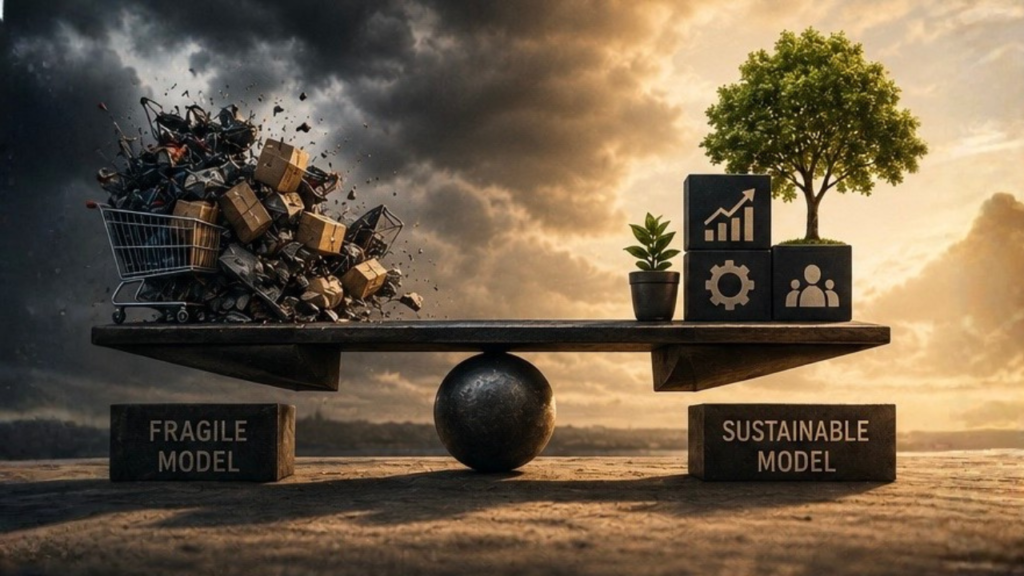
This highlights an important leadership lesson: scalability without flexibility creates fragility.
What Makes These Industries Vulnerable?
Several common factors connect the industries facing the greatest risk:
- Heavy dependence on imported materials
- Thin operating margins
- Limited pricing flexibility
- Supplier concentration
- Lack of diversified revenue streams
- High operational overhead
- Low financial reserves
Grant (2022) explains that a sustainable strategy depends on resource flexibility and environmental adaptability. Businesses built entirely around one unstable supply chain become highly vulnerable during economic disruption.
This is why many businesses that appear successful externally may actually be financially fragile internally.
A Leadership and Marketing Perspective
One of the most overlooked aspects of entrepreneurship is understanding that leadership decisions shape financial outcomes.
Many entrepreneurs continue investing in failing systems because they are emotionally attached to past investments. This resembles what economists call the sunk cost fallacy, in which individuals continue to support ineffective strategies simply because substantial resources have already been invested.
This mindset appears not only in business but also in branding and marketing decisions.
Entrepreneurs often overspend on:
- Expensive software
- Excessive subscriptions
- Luxury branding
- Paid advertising before validation
- Large teams before profitability
The pressure to “look established” often causes entrepreneurs to scale appearances faster than systems.
As I continue building The Now Academy, The Now University, and The Pulse of Marketing ecosystem, I constantly remind myself that sustainable growth matters more than visible hype. Every tool, platform, and expansion decision must align with long-term flexibility and operational sustainability.
That is why entrepreneurs must stop asking: “How can I look bigger?” And start asking: “How can I become stronger?”
Practical Strategies for Entrepreneurs in 2025
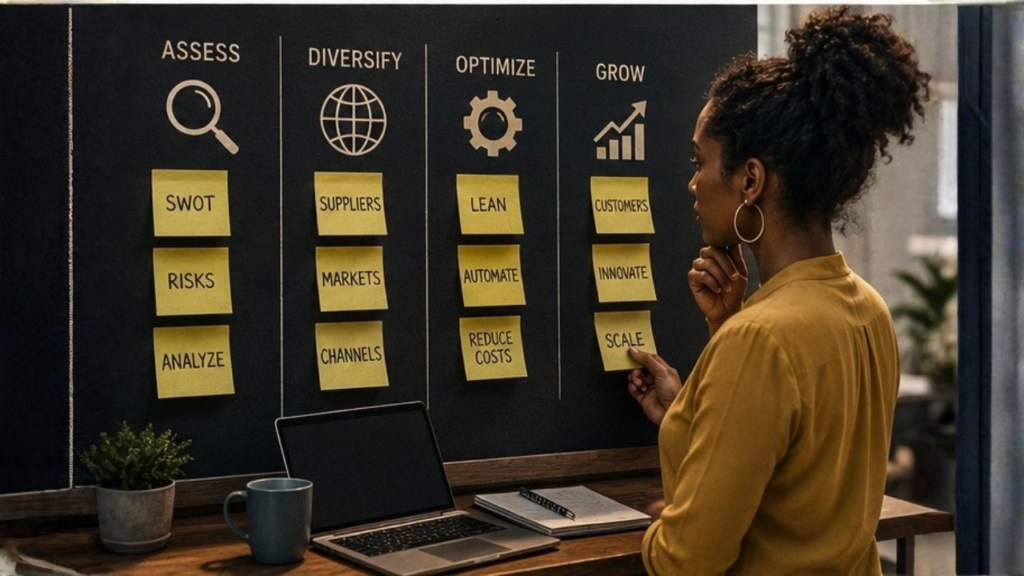
Although these challenges are serious, entrepreneurs are not powerless. Businesses that adapt strategically can still survive and grow.
1. Conduct Frequent SWOT Analyses
Businesses should reevaluate strengths, weaknesses, opportunities, and threats every 30–60 days during periods of economic uncertainty.
This creates awareness before crises escalate.
2. Diversify Supply Chains
Entrepreneurs should explore:
- Domestic suppliers
- Nearshore manufacturing
- Alternative sourcing regions
- Backup vendor relationships
Even partial diversification increases resilience.
3. Build Lean Operational Systems
Lean systems reduce unnecessary expenses and improve flexibility.
This may include:
- Reducing software subscriptions
- Consolidating vendors
- Simplifying operations
- Automating repetitive processes
4. Strengthen Customer Retention
According to Harvard Business Review (2023), increasing customer retention by just 5% can substantially increase profits.
Loyal customers reduce dependence on constant acquisition spending.
5. Develop Ecosystem Thinking
One of the most important lessons entrepreneurs can learn is ecosystem thinking.
Strong businesses create interconnected systems:
- Content feeds the community
- Community feeds offers
- Offers feed recurring revenue
- Recurring revenue funds innovation
Businesses operating in isolated silos often struggle more during economic disruptions.
Reflection Questions for Entrepreneurs
As you evaluate your own business, ask yourself:
- Is my business overly dependent on imports?
- Can my margins survive continued tariff increases?
- Am I building systems or just appearances?
- What would happen if my primary supplier disappeared tomorrow?
- Am I positioned for flexibility or fragility?
These are uncomfortable questions, but strong leadership requires honest evaluation.
Conclusion
Navigating 2025: Businesses to Avoid Amid Rising Tariffs requires more than hustle. It requires strategy, adaptability, humility, and disciplined leadership.
Some industries may face greater challenges than others under rising tariffs, especially businesses heavily dependent on imported goods and fragile supply chains. However, entrepreneurs who remain flexible, build lean systems, diversify strategically, and prioritize sustainability over appearances will position themselves to survive and scale.
The businesses that thrive in 2025 will not necessarily be the loudest. They will be the most adaptable.
Ready to Build Smarter?
That is exactly why I created The Now University ecosystem: to help entrepreneurs move from confusion to clarity and from reactive decision-making to strategic growth.
Inside the program, we focus on:
- Sustainable business systems
- Marketing strategy
- Pricing confidence
- Leadership development
- Digital positioning
- Long-term scalability
You do not have to navigate uncertain markets alone, because real business growth is not about hype. It is about building something strong enough to survive pressure.
References
Armstrong, G., & Kotler, P. (2020). Marketing: An introduction (14th ed.). Pearson.
Associated Press. (2025). Textile industry disruptions amid tariff increases.
Grant, R. M. (2022). Contemporary strategy analysis (11th ed.). Wiley.
Harvard Business Review. (2023). Customer retention and long-term profitability.
Kotler, P., & Keller, K. L. (2016). Marketing management (15th ed.). Pearson.
Liberty Street Economics. (2024). Import dependency and tariff exposure among U.S. firms.
Reuters. (2025). U.S. food manufacturers face rising import costs amid tariffs.
The Budget Lab at Yale University. (2025). Economic impact of tariff increases on U.S. consumers and businesses.
The Wall Street Journal. (2025). Small business concerns over tariff uncertainty.
Yukl, G., & Gardner, W. L. (2020). Leadership in organizations (9th ed.). Pearson.