
Marketing vs. Selling is one of the most important distinctions entrepreneurs must understand. While marketing builds awareness, trust, and customer relationships, selling helps turn that interest into purchasing decisions. Understanding how both work together is essential for sustainable business growth.
Many entrepreneurs think they have a marketing problem when they really have a selling problem. Others think they need to become better salespeople when their real challenge is that they have never built enough awareness, trust, or perceived value for the sale to happen naturally.
That distinction matters. I have said for years, “You don’t have to know how to sell, but you do have to know how to market.” I don’t mean selling is unnecessary; selling is essential. My point is that when marketing is done well, the sales conversation begins long before someone asks, “How much does it cost?” That brings us to Marketing vs. Selling: What’s the Difference and Why Most Entrepreneurs Get It Wrong.
Marketing and selling are related, but they are not interchangeable. Marketing creates, communicates, and delivers value to a defined market. Selling helps a prospective customer move from interest to a purchasing decision; one creates the environment for demand, and the other helps convert that demand into action. The strongest businesses understand that they need both.
Marketing Creates Value Before the Transaction

Let us start with marketing. Armstrong et al. (2026) frame modern marketing around creating customer value and building profitable customer relationships. That definition immediately moves us beyond social-media posts, advertisements, logos, and promotions.
Those are marketing activities; they are not marketing itself. Marketing starts with understanding people. Who are they? What problem are they trying to solve? What do they value? What alternatives do they have? Why should they trust you? And, perhaps most importantly, why should they care?
This is one reason Marketing vs. Selling: What’s the Difference and Why Most Entrepreneurs Get It Wrong is such an important question for small-business owners. If you reduce marketing to promotion, you can become extremely busy without becoming strategically effective.
I learned this lesson myself; at one point, I thought visibility was the answer: Facebook, Instagram, email, webinars, and content. I was showing up everywhere; I was visible, but visibility without clarity is just noise.
The shift occurred when I became more intentional about whom I was trying to serve and what transformation I was actually offering them. Instead of trying to speak to everybody, I learned to communicate to somebody. That is marketing.
This aligns with the broader organizational principle described by Ivancevich and Konopaske (2023): human behavior is shaped by perceptions, motivations, attitudes, and social environments. Customers do not enter the marketplace as purely rational machines comparing feature lists. They interpret brands and offers through their experiences, expectations, needs, and perceptions.
So good marketing does not begin with: “What do I want to sell?” It begins with: “Whom am I serving, and what do they value?”
Selling Converts Interest Into Commitment

Now we get to selling. Imagine that someone has watched your videos for three months. They read your emails, download your guide, follow you on social media, and believe you understand their problem. That is marketing doing its job, but then what?
Some entrepreneurs keep posting, and posting, and posting. Eventually, they become frustrated: “Everybody likes my content, but nobody buys.” Fam, at some point, you have to ask for the business. Selling moves interest toward commitment. It involves understanding needs, answering questions, addressing legitimate objections, communicating value, and providing a clear next step.
That is another reason understanding Marketing vs. Selling: What’s the Difference and Why Most Entrepreneurs Get It Wrong can change the way you operate.
Marketing might generate attention without producing a transaction. Selling without sufficient marketing, however, can force you into constantly chasing people who do not know you, trust you, or understand your value. Neither extreme is healthy.
Research on the marketing-sales interface reinforces this point. Hughes, Le Bon, and Malshe (2012) argue that lasting customer value depends partly upon effective coordination across organizational functions. Likewise, Biemans et al.’s (2022) systematic review of more than 25 years of research demonstrates that the relationship between marketing and sales remains central to satisfying customers and achieving organizational objectives.
In other words: Marketing and sales have different jobs, but they should be working toward the same mission.
Marketing Pulls. Selling Guides.
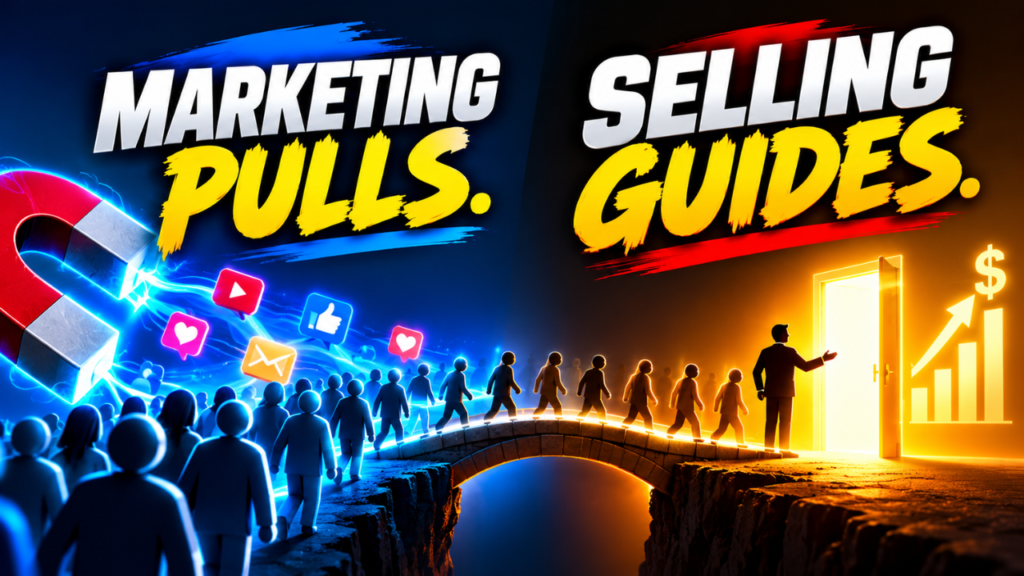
Here is a simple way I teach the distinction: Marketing creates the invitation; selling helps people decide. Marketing says: “I understand your problem.” Selling asks: “Are you ready to solve it?” Marketing builds awareness; selling facilitates commitment.
Marketing communicates value at scale; selling often communicates value at the individual decision level. Marketing nurtures; selling closes. Neither function should manipulate people; that matters to me. Marketing should never be about tricking someone into wanting something they do not need. Likewise, selling should not mean pressuring someone into making a decision that is wrong for them.
Jesus taught, “For where your treasure is, there will your heart be also” (Matthew 6:21, King James Version). Business also reveals something about our hearts. If revenue becomes the only objective, customers eventually become numbers, not people. But sustainable business requires creating real value for real human beings; that is where service and strategy meet.
Why Entrepreneurs Confuse Marketing and Selling
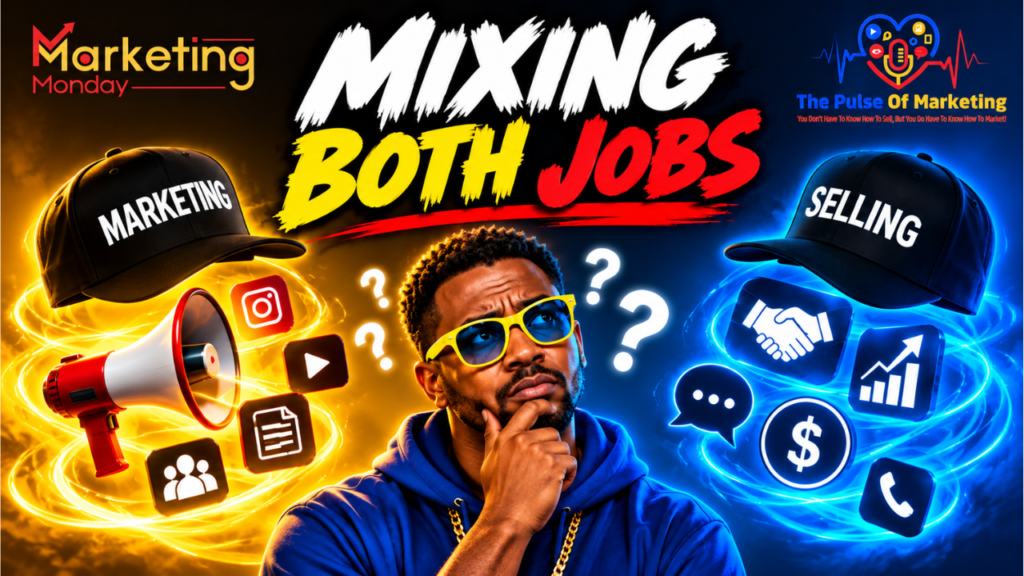
One reason Marketing vs. Selling: What’s the Difference and Why Most Entrepreneurs Get It Wrong persists is that entrepreneurs often do both functions themselves. In a large organization, there may be a marketing department and a sales department.
In a small business? You are marketing, sales, and customer service. You might also be accounting, operations, social media, and the person wondering why the printer stopped working. The functions blur together.
Academic research shows that the distinction remains meaningful even inside organizations. Homburg and Jensen (2007) found that differences between marketing and sales perspectives can hinder cooperation and, in turn, market performance. Homburg et al. (2008), studying 337 European companies, likewise demonstrated that marketing-sales relationships can take substantially different organizational forms.
For the entrepreneur, the practical lesson is straightforward: Separate the functions mentally, even when you cannot separate them organizationally. When you create educational content, clarify your positioning, conduct customer research, build brand awareness, or nurture your community, you are primarily doing marketing.
When you conduct a discovery call, recommend a solution, present an offer, answer objections, follow up with a qualified prospect, or ask for the commitment, you have entered the selling process. Once you recognize which hat you are wearing, you can diagnose problems more accurately.
Marketing Without Selling Creates Attention Without Revenue
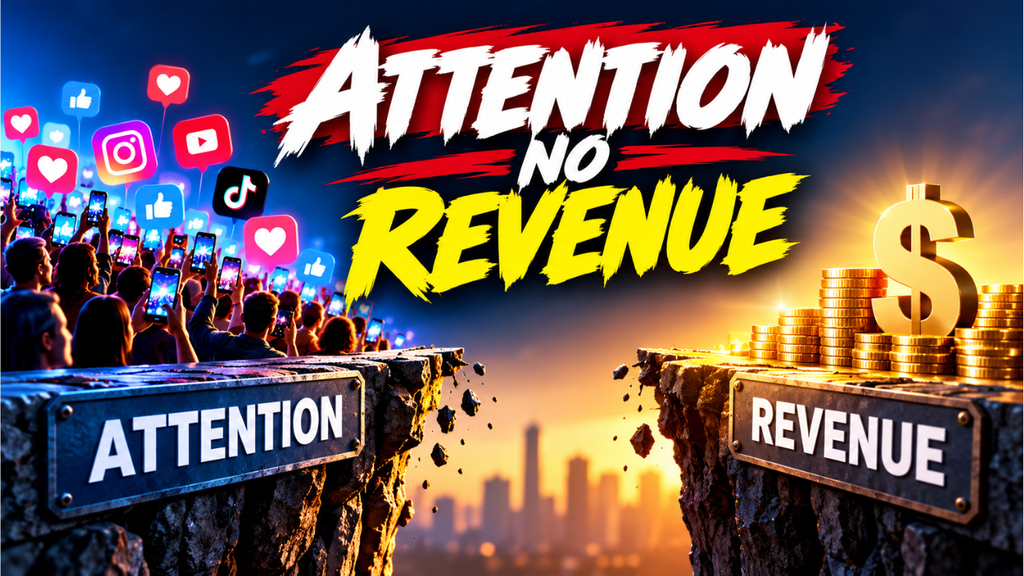
Here is where things get uncomfortable. Followers, views, and likes aren’t customers; even leads aren’t customers. They can become customers, but you need a bridge between attention and transaction. I have watched entrepreneurs celebrate a post reaching thousands of people while having no system to capture contact information, nurture those relationships, present an offer, or follow up.
That is not a business model; that is attention. Schermerhorn (2011) emphasizes the managerial importance of planning, organizing, leading, and controlling resources toward performance objectives. In entrepreneurship, attention becomes strategically valuable when systems convert appropriate audience interest into customer relationships.
That is also why Marketing vs. Selling: What’s the Difference and Why Most Entrepreneurs Get It Wrong is not merely a semantic debate; confusing the two can lead to poor diagnosis.
If people do not know you exist, you probably need marketing. If people know you exist but do not understand what you do, you probably have a positioning or messaging problem. If qualified prospects understand your offer but never receive a clear invitation to buy, you probably have a selling problem.
If customers buy once but never return, you may have a customer-experience, product, or retention problem. Do not prescribe the same medicine for every business symptom.
Selling Without Marketing Creates Exhaustion
The opposite problem is equally dangerous. If you do not market effectively, you may spend your entire business life chasing customers. Cold message, pitch, follow up, pitch, follow up again, and start over tomorrow. That can become exhausting because every transaction begins at zero.
Effective marketing builds assets that make future selling easier: reputation, useful content, email lists, communities, customer relationships, referrals, intellectual property, search visibility, and brand equity. Over time, those assets can compound.
That connects directly with what I discuss in Quit or Shut Up. Transformation rarely comes from one emotional burst of activity. Sustainable progress requires consistency, structure, and the willingness to stick with the process (Chaplin, 2026).
Business is no different. You cannot disappear for six months, market aggressively for seven days because you need money, and then get angry because your audience did not respond immediately.
Trust compounds through consistency.
Galatians 6:9 reminds us, “And let us not be weary in well doing: for in due season we shall reap, if we faint not” (King James Version). That Scripture contains a business principle, without reducing the verse to a business slogan: harvesting follows sustained faithfulness.
Plant, cultivate, nurture, then harvest. Marketing plants and cultivates; selling helps harvest appropriate opportunities.
The Goal Is Alignment
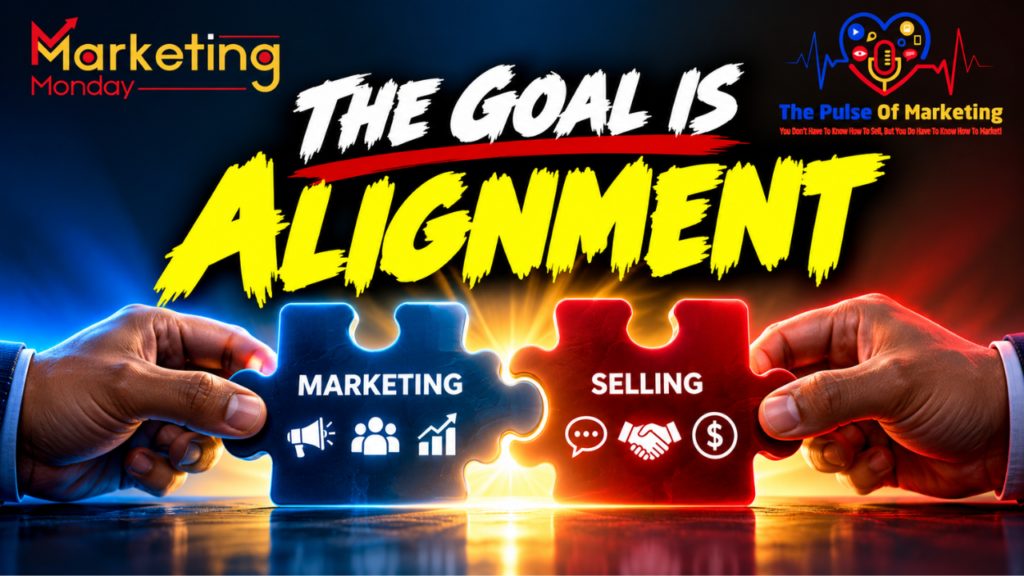
So what should you do? Stop asking whether marketing or selling is more important. Ask whether they are aligned.
Research consistently points toward the importance of that alignment. Hughes et al. (2012) describe the marketing-sales interface as part of the organizational coordination needed to develop market-based capabilities and lasting customer value. Research involving small and medium-sized enterprises has likewise shown that sales and marketing perform distinct activities while depending on strategic and operational alignment for effective implementation (Malshe et al., 2017).
For a small business, alignment can be surprisingly practical. Your marketing promise should match your sales conversation; your sales conversation should match your offer; your offer should match the customer’s problem; your delivery should match what you promised; and your customer experience should reinforce why they trusted you in the first place.
That creates a continuous system:
Attention → Trust → Conversation → Offer → Decision → Delivery → Relationship → Advocacy
Now you are not simply marketing; you are not simply selling; you are building a business.
Build the System, Not Just the Sale
If you take only one idea from Marketing vs. Selling: What’s the Difference and Why Most Entrepreneurs Get It Wrong, take this: Marketing creates the conditions for the sale; selling helps the right customer decide. You need both.
Marketing without selling can create popularity without profitability; selling without marketing can create revenue without leverage. But when marketing and selling work together, something different happens. Your message attracts the right people, your content develops trust, your offer addresses a meaningful problem, your sales process creates clarity, and your customer experience validates the promise.
That is how you move from chasing transactions to building relationships, and that is how you build something sustainable. Proverbs 21:5 says, “The thoughts of the diligent tend only to plenteousness” (King James Version).
Build deliberately, market consistently, sell ethically, serve exceptionally, then keep improving the system.
Ready to Build More Than a Business?
Understanding Marketing vs. Selling helps entrepreneurs stop chasing transactions and start building a system that attracts, converts, and retains customers.
If you are tired of guessing your way through entrepreneurship and ready to build the structure, leadership, strategy, accountability, and execution behind sustainable growth, The Now University was built for that journey.
The goal is not simply to teach you how to make another post or chase another sale. It is to help you think like a leader, build like an entrepreneur, and develop systems that can support the vision God has placed in you.
Because eventually, the question changes from: “How do I make this sale?” to: “How do I build something capable of serving people consistently?” That is the shift. Build the leader. Build the business. Build what lasts.
References
Armstrong, G., Kotler, P., & Balasubramanian, S. (2026). Marketing: An introduction (16th ed.). Pearson.
Biemans, W., Malshe, A., & Johnson, J. S. (2022). The sales-marketing interface: A systematic literature review and directions for future research. Industrial Marketing Management, 102, 324–337. https://doi.org/10.1016/j.indmarman.2022.02.001
Chaplin, L. J. (2026). Quit or shut up. Hemingway Publishers. https://quitorshutup.com
Homburg, C., & Jensen, O. (2007). The thought worlds of marketing and sales: Which differences make a difference? Journal of Marketing, 71(3), 124–142. https://doi.org/10.1509/jmkg.71.3.124
Homburg, C., Jensen, O., & Krohmer, H. (2008). Configurations of marketing and sales: A taxonomy. Journal of Marketing, 72(2), 133–154. https://doi.org/10.1509/jmkg.72.2.133
Hughes, D. E., Le Bon, J., & Malshe, A. (2012). The marketing-sales interface at the interface: Creating market-based capabilities through organizational synergy. Journal of Personal Selling & Sales Management, 32(1), 57–72. https://doi.org/10.2753/PSS0885-3134320106
Ivancevich, J. M., & Konopaske, R. (2023). Organizational behavior (12th ed.). McGraw-Hill.
Malshe, A., Johnson, J. S., & Viio, P. (2017). Understanding the sales-marketing interface dysfunction experience in business-to-business firms: A matter of perspective. Industrial Marketing Management.
Schermerhorn, J. R., Jr. (2011). Management (11th ed.). John Wiley & Sons.